
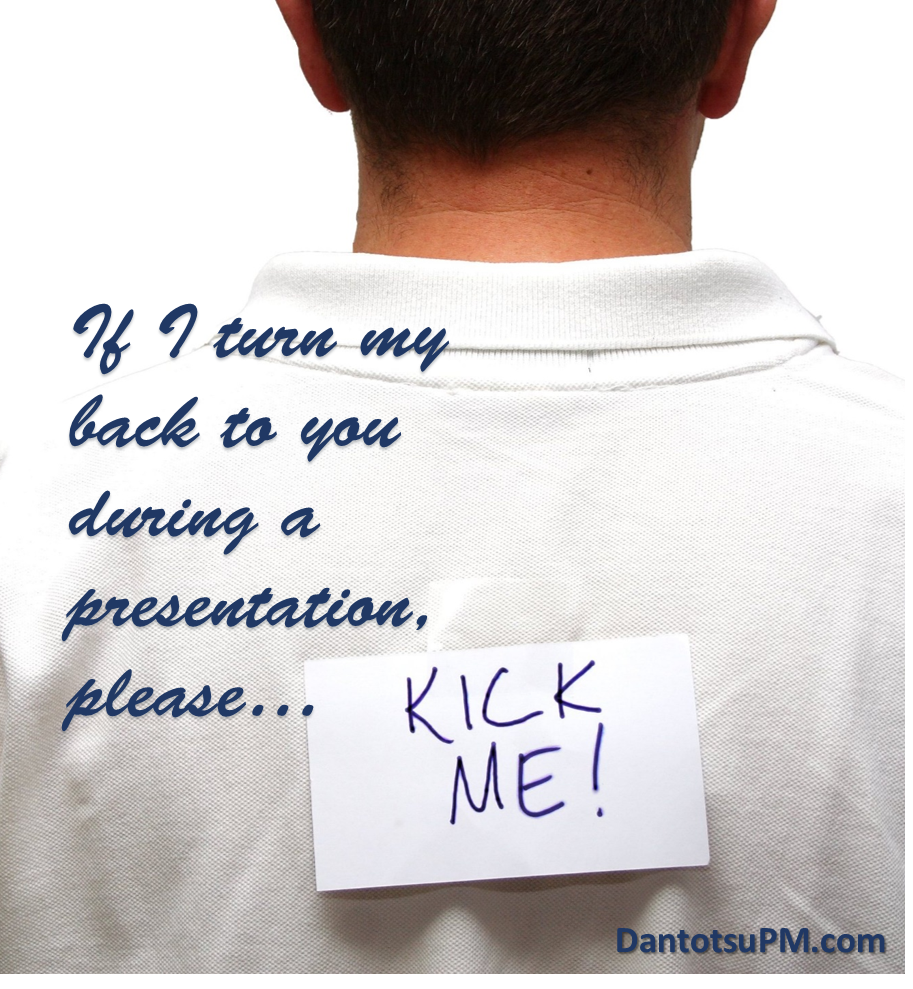
Quite like the author of the post » Preparing to present at conferences « , I spent many hours looking at the back of presenters as they were reading bullet point slides on the screen.
In fact, I must confess culprit: I made this error many many times.
 And, I do not think that I should feel so ashamed about it. In the French educational system, at the time when I was a student, nobody explained to me how to prepare and deliver high quality presentations, how to speak in public and how to effectively communicate messages via presentations.
Fortunately, I was able to witness that this lack of education has changed with my daughters and nephews who had many opportunities during their engineering or management curriculum to deliver individual and group presentations to expose their work and team results with the support of PowerPoint slides and other technologies.
Although I’m certainly far less experimented on the subject than the authors of the above mentioned post, here are a few points that I personally try to stick to:
1. Be clear on your message and on who are the participants
Know exactly the message which you would like the audience to retain at the end. It’s not so easy… You probably will have to do some research on the audience itself to adapt your contents and style. You should also understand what the organizer of the event expects from you. Check who else will intervene at the event…
What would you like to see the participants do or change after your presentation? How will you measure the impact of your speech?
2. Take the necessary time to properly prepare the presentation.
Even on a well mastered topic, it is important to carefully prepare your intervention. Analyze the audience and the objectives to reach, as well as the physical and material conditions of the presentation. How will you tailor your contents based on these?
Do not to jump into PowerPoint from the start.
Start with writing on paper or on a whiteboard the scenario, the storyboard of what you wish to communicate. Structure the talk before reflecting on how to translate this at best in presentation slides.
3. Avoid busy slides.
The presentation is only a support to the speech. It needs to facilitate the memorization by the audience of some of the elements that you communicate, in particular with the help of pictures and striking illustrations.
When presenting in front of a wide audience, there is no point in having a lot of text on your slides!
It is far more efficient to create an emotion, send a message, tell a story which the audience will remember easily and on which it will take action. Make people think, trigger their brain. An effective presentation is a presentation of which you can see the effects as would say Ben Johnson, my professor of « Effective Meetings and Presentation Skills ».
4. Rehearse, rehearse, rehearse…
 The D-day, the speech must be fluid, natural, and appear like it’s not been too much prepared. No benefit in reading your slides during the presentation, they are and must remain « only » a support to your words which you master from A to Z.
You will also have prepared a few anecdotes and references from your personal experience to give life to your arguments. Try to anticipate at best the questions, and ask these to yourself if they do not come spontaneously. In case of a silence at the beginning of a Q&A session you may launch the debate: « I see that you’re still reflecting on what I just shared with you. You may be asking yourself the question: xyz. It’s a very valid question. Let me share a few elements to address to this xyz legitimate question ».
5. Check the room and the material conditions of the intervention far in advance.
Which type of microphone for example: fixed(to be avoided), clip-on microphone, or hand held microphone. This will influence, and possibly limit your moves. It is better to be aware of these conditions in advance and plan for it.
The size of the room is also an important factor as well as the scene on which you will evolve.
 Moving the slides forward&backward: Will it be done via remote control, operator (it will be necessary to prepare this person in advance), keyboard that you manage yourself (if you moved, which is recommended, you’ll have to go back to the PC to advance slides)… This impacts the dynamics of your show and choice of animation for your slides.
If you plan to use sound or video during the presentation (a good idea to energize long sessions), please make sure that they work well in the room, both visually and acoustically, and this, even from the very back of the room.
Plan to have a glass of water during the presentation. It allows you to avoid having a dry throat and it also allows stopping for a few seconds to think during the course of your speech.
6. Prepare a paper to accompany the presentation and supply your presentation pack well in advance
Supplying your presentation pack well in advance is a good idea even when it is not expressly required by the organizer. It forces you to be 100% ready well ahead of the event. In your final reading, a few days before the intervention, you can simply review and decide upon the examples which you plan to use and the stories to be told according to the latest events and news.
It’s also a good idea to plan for a Word, Acrobat or Web post to leave something behind your intervention. At the start of your speech, please indicate that this document exists and where to find it so that the participants may focus on listening to what you have to tell rather than trying to take notes.
 7. Never exceed your speaking time

It is unfair to the audience and it impacts any other presenters that come after you. It’s a good idea to ask the organizer or someone in the audience to give you some timing signs (10 mintes to go, 5 minutes, last minute).
What else would you add to complement this initial list?











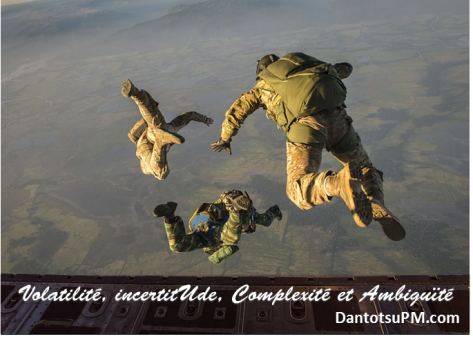 La signification plus profonde de chaque élément de VUCA permet de mieux comprendre l’intérêt stratégique de VUCA aussi bien dans les comportements de groupes et personnes que dans les organisations.






 Pas besoin d’être un expert en management ou consultant en productivité pour savoir que les interruptions dans votre travail ont un coût très élevé. Il faut souvent plusieurs minutes pour reprendre le fil de ses pensée et de son action après avoir répondu au téléphone, à un message instantané, ou au « pop up » ou autre signal visuel ou sonore d’arrivée d’un message dans sa boite de messagerie. Je vous propose de faire un essai pendant une semaine. Tous les matins, car c’est souvent une période de forte productivité si l’on est concentré, changez la vitesse de rafraichissement de votre boite à lettre à 90′ pour vous créer deux plages de concentration continue pendant lesquelles vous arrêterez aussi votre messagerie instantanée (ou la mettrez sur ne pas déranger), votre téléphone fixe sur répondeur et votre téléphone mobile sur silence (et le rangerez hors de vue).
 Ne pas accomplir une « obligation » (comme l’envoi de vos cartes de vœux en ce début d’année) peut vous faire vous sentir coupable. Mais si vous cherchez à progresser professionnellement, une carte de vœux (enterrée sous un déluge de cartes) fera-t-elle une différence ? Si vous vous voulez garder le contact, faites quelque chose d’inhabituel, prenez contact avec ces personnes à une saison différente, ou téléphonez à vos contacts, ou encore mieux, rencontrez-les en face à face.
 3. Lire des choses inintéressantes.
 Tout travail comporte son lot de sujets intéressants et de tâches plus fastidieuses. Mais si la balance pèse très/trop largement du second côté, il est peut-être temps de changer de projet, position, entreprise, secteur… Comme le dit un ami aventurier: « La vie est bien trop courte pour la perdre à la gagner ».



 Si vous pouviez voir mon agenda, vous y remarqueriez probablement une foule de créneaux horaire grisés, mais sans indication d’activité. Il n’y a aucun problème avec mon Outlook ou imprimante. Les sections grisées reflètent « des tampons », des périodes j’ai volontairement gardées libres de réunions.
 Il y aura toujours un besoin de faire faire des choses et de cocher un autre item de la ‘to do’ liste. Cependant, comme la société devient plus grande, comme la largeur et la profondeur de vos initiatives s’étendent – et comme le paysage compétitif et technique continue de changer à un rythme qui s’accélère – vous aurez besoin de plus de temps que jamais auparavant pour simplement penser : Penser à quoi la société ressemblera dans trois à cinq ans; penser à la meilleure façon d’améliorer un produit déjà populaire ou répondre à un besoin client non satisfait; penser comment vous pouvez accroitre un avantage compétitif ou réduire un écart avec un compétiteur, etc.
 Par-dessus tout, la raison la plus importante de prévoir des créneaux libres est simplement de reprendre votre souffle.
 Utilisez ce laps de temps pour penser en grand, rattraper votre retard sur les dernières nouvelles de votre industrie, sortir de dessous cette pile de courriers électroniques non lus, ou faire juste une promenade. Quoi que vous fassiez, assurez-vous simplement que vous prenez ce temps pour vous – chaque jour Et d’une façon systématique – et ne laissez pas ces moments non planifiés à la chance. Le « créneau de temps libre » est le meilleur investissement que vous pouvez faire en vous-même vous et l’outil de productivité le plus important que j’utilise.


 Nous approchons des vacances d’été et, comme nous le rappelle Elizabeth, même si nos projets ont extrêmement bien fonctionné cette année, nos délais soigneusement planifiés ne sont plus toujours bien alignés sur les dates pendant lesquelles nous allons nous absenter…
 Signature de courrier électronique, coordonnées, Etc
  Ils doivent simplement être mis au courant :
 Je suis au congé annuel jusqu’au vendredi 24 juillet 2015 inclus. Je n’aurai pas accès à mon courrier électronique pendant cette période. Si votre question est urgente, contactez s’il vous plaît :
 Bloquez du temps dans votre agenda à votre retour reprendre à charge votre projet de la personne qui s’en occupait pour vous.




 DantotsuPM.com
