Nobody starts to prepare such a certification with the intent to quit along the way. And even less PMs who are by definition strong, hard at work, sound, and who hate to fail. Nevertheless when I mention the topic with some of my PMI colleagues who became trainers in project management, they mention significant drop rates along the way. So, the question is upon us, why? And especially, how avoid such a waste of time, if it is one, but it is not always the case as we shall see later on.
some participants underestimate the difficulty
 The PMP certification is relatively hard and difficult. Sin of pride? The future PMP is often already very experimented. He lead to a successful conclusion quite a lot of projects of diverse sizes and maybe in several companies and different domains. He is confident about his capacities, skills, will, and it is not necessarily a bad thing. The issue is not to under estimate the amount of work to be carried out to get prepared. My own recollection is that it is indeed one of the most difficult tests which I have ever taken. Naturally, there will be always persons who will ignore the warnings and who will think that the trainers exaggerate. For example, the participants who were rather fortunate in their initial studies and made for example successful bets on the subjects of future exams, will be at difficulty with the certification. They can go as far as taking the test the first time simply thinking that they will always easily distinguish the correct answer in a test with multiple choices. It is not the case. There are very often at least two plausible or possible answers because PMI wants to be certain that the person understands the difference between these answers and chooses the best. Only a serious preparation will allow you to make such good choices.
The participants who work in organizations which use PMI start with a slight advantage, but will they know how to preserve it?
 The use of the PMBOK and the PMI processes in your organization gives you a sure advantage. You understand already how much and how the processes of project management are integrated to be effective. The company in which I worked when I took the PMP test, NCR International Corporation, uses the principles and the process of PMI. The training courses allowed me to formalize this practical knowledge by adding the theoretical bases. I also encountered certain domains where I needed to further study such as suppliers and contracts management. Thus, if your organization already follows the processes and the best practices of the PMBOK, you have acquired without realizing it a good portion of the knowledge required and can answer easily many questions of the test. It does not mean that you can pass the exam without preparation nor work. It does not mean either that a person cannot learn these processes if their organization does not use them daily. In this case, it will simply be necessary for you to make the necessary time and effort to become an expert of the project management processes proposed by PMI.
Develop a solid work plan
Most of the students who took the PMP will tell to you that a work plan which follows the diverse process of the PMBOK and their definitions is very useful. As there is a lot of ground to be covered, it is particularly interesting to establish how you will estimate your progress. Thus, it is necessary to include practice tests with questions similar to those of the PMP exam. If you have the chance to be a part of a group of persons who prepare together for the examination, you will want to test one another. It will motivate you and will strengthen your links with your classmates. The training companies also propose sets of test questions. The most interesting part of the courses face to face is often the correction of these training tests with the professor who will explain why only one answer was best. In this phase, do not try to counter him, it is of no interest. It is necessary to open very widely your ears to understand the logic of PMI. The questions where you have made the errors in the study phase can become your assets the day of the real test. Your progressive work plan of study will have to lead you to learn the five groups of processes and nine domains of knowledge and recall each of them, that is imperative for the test. This plan should also allow you to confirm your availability for the necessary efforts. If it is not the case, maybe should you simply focus your work on the sectors in which you have the greatest gaps to get short-term benefits from your training classes without going for the certification.
To know, about the test
The test with multiple choices answers of PMI will often provide you with a scenario and ask for an answer. The formulation of the question is very important to understand what the examination tries to know. So, read the question attentively several times, at least 3. Then read the proposed answers. Certain long questions of this type may confuse you by the quantity of information and data which are presented there, some useful, others not. In order not to get lost, one of the best suggestions for these questions is to begin by reading the question. You will then identify more easily the most important data of the scenario when reading it. This will allow you to find the answer quickly. You need to practice this before the test so that it becomes an automatism.
 The test environment can be intimidating. I passed, for my part, on paper form. Finding yourself in a test room with several dozens of other candidates, one per table, without any document, with supervisors and limited timed (4 hours) is puzzling when you took your last examination more than 15 years ago. The certification on PC is I think less intimidating from this point of view even if certain sites are equipped, I believe, with video cameras which will film you from A to Z during the test.
It is perfectly understandable that you are nervous when passing a certification of an international level. But, honestly, most of the project managers whom I know have an excellent resistance to stress and if you are prepared well, you will not fail. This is only a test after all!
Please remember that it is the preparation for the examination which really brings you value (new skills, theoretical bases, reflecting on your practices, repeatable processes), the certification is only a recognition (eventually rewarded in cash on future jobs).








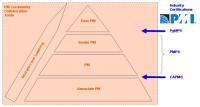
 why are Project Management certifications important?
 Le susdit est dans l’intérêt de la compagnie …
 I suggest in this note looking closely at the ways each of us could improve the effectiveness of the trainings in which we get the chance to participate. This is only a personal return of experience and I encourage you to enrich it with your comments.
 Other important criterion: pre-requisites. Do I have the experience and the necessary knowledge so that this learning can be beneficial? If I attend an advanced class of preparation for the PMP® certification without the required experience (3 years minimum as a PM) and without having done the preliminary classes, there is a strong risk that it’ll be of little value.
 Considering my workload, is the timing convenient to undertake this training course? I had the chance to follow several intense education programs (several months long): IT consulting university, preparation for the PMP® certification, Intrapreneurship University. All three were very dense and demanding with long periods out of the office and far away from home. With on top of it, personal work I had to provide between the classes of the programme, and requiring availability and concentration. If I engage in a long cursus: will my family bear with me?
 Let’s not waste time pointlessly seeking classes which would not be approved (unless you have decided to pay from your own pocket or to use your DIF for the French people). Of course, my ability to convince can be essential as well as my positioning of the training in a logical manner with regard to my job and ambitions. But, the budgets are not extensible and some classes very expensive in cost and at time: so, do not jump this step. Will my boss be ready to help me to put into practice what I will learn: new tasks, responsibilities or projects, with coaching (by him or others), by giving me some time to prepare for the certification …
 Diverse vectors of research are to be used: the human resources department of the company, colleagues, manager, the Internet and especially professional forums and blogs, the training companies and bodies… For larger studies, it is also interesting to take into account: the reputation of the provider and of its education programme, the trainer (a lot of information on internet if you succeed in obtaining a name). For example, some trainers for the PMP® Exam preparation have a success rate of their students that is close to 100 %. Select these!
 I cut the telephone, emails, and I took my precautions to avoid any non-absolutely critical interrupt. The periods of training are rare enough that we take advantage of these well by dedicating ourselves 100 %. I thus made sure that all those who could need to join me as a matter of urgency know who to contact in my place or at what time I shall be contactable. Personally, I try to set time slots to read urgent emails, check the answering machine and SMS in an asynchronous mode (i.e. when it is the best moment for me) and I stick to these.
 It is necessary to create for ourselves opportunities to practice what we recently acquired. Otherwise we’ll very rapidly forget it. If the initial preparation stage prior to the course was well followed, I have defined my motivations for this training and convinced my boss to invest in me. It is necessary upon my return to review this list of motivations and to turn it into a list of concrete objectives to implement in order to really master the new skill. For example, if I attended a class on risk management, I will commit upon return to revise within a couple of weeks the risk analysis of my main project (in the lights of the new methodology) and to produce corresponding deliverables: risks register, risk evaluation, priorities, risk management plan, method for periodic control … If it was a course on the presentation skills, I try to create an opportunity in the month to come to deliver a presentation to a wide audience…
 I met new persons (including the trainer). Some of them very interesting and with whom I have discovered affinities. I’ll keep in touch. I’ll send them a message after the class, suggest remaining connected via a professional network (Linkedin, Viadeo or others), send them regularly some news about me and interesting articles on the subject we studied together, if possible I’ll organizing meetings to keep the link alive…

 Quelles sont mes motivations pour cette formation? Me sera-t-elle réellement utile dans un futur relativement proche? Personnellement, j’évite toute formation spécialisée dont je ne pense pas pouvoir utiliser les enseignements dans les 3 mois. Cette réflexion permet également de préparer l’ « Après formation ».
 Le moment est-il propice compte tenu de ma charge de travail pour suivre cette formation? J’ai eu la chance de participer à plusieurs programmes musclés de formation sur plusieurs mois : école de consulting informatique, préparation au PMP®, Intrapreneurship University. Les trois furent très intenses et exigeants avec des périodes de plusieurs semaines hors du bureau et loin de la maison. Avec en sus, du travail personnel et d’équipe à réaliser entre les étapes de la formation et exigeant une disponibilité d’esprit et de concentration. Une question à se poser pour une formation longue: Ma famille me supportera-t-elle?
 Bien sûr, mon habileté à convaincre peut être primordiale ainsi que ma capacité à bien positionner la formation de manière logique par rapport à mon job et mes ambitions. Mais, les budgets n’étant pas extensibles et certaines formations très chères en argent et en temps.
 Divers vecteurs de recherche sont à exploiter: le département ressources humaines de l’entreprise, les collègues, le manager, le web avec en particulier les forums et blogs professionnels, les organismes de formation… Il est également intéressant de prendre en compte pour des formations supérieures ou plus longues : la réputation de l’organisme et du cursus de formation, le formateur (beaucoup d’infos sur internet si vous parvenez à obtenir son nom). Par exemples, certains formateurs à l’examen PMP® atteignent des taux de réussite de leurs élèves qui frisent les 100%. Autant choisir ceux-là!
 Je coupe le téléphone, les emails, et je prends mes précautions pour éviter toute interruption non réellement critique. Les périodes de formation sont suffisamment rares pour bien en profiter en s’y consacrant à 100%. Je m’assure donc que tous ceux qui peuvent avoir besoin de me joindre en urgence sachent qui joindre à ma place ou à quelle heure je serai joignable. Je me définis des créneaux pour vérifier de manière asynchrone (quand c’est le bon moment pour moi) les emails, répondeurs téléphoniques, SMS… et je n’en déroge pas.
 Il faut se créer les opportunités de pratiquer ce que nous avons récemment acquis sous peine de l’oublier très rapidement. Si l’étape de préparation a bien été suivie, j’ai défini mes motivations pour cette formation et convaincu mon chef d’investir sur moi. Il est nécessaire au retour de formation de reprendre cette liste de motivations et d’en faire une liste d’objectifs concrets à mettre en œuvre pour réellement maîtriser cette nouvelle compétence. Par exemple, si j’ai assisté à un cours sur le management des risques, je m’engage au retour à revoir sous quinzaine l’étude des risques de mon projet principal aux lumières de la nouvelle méthodologie et de produire les livrables correspondants: registre des risques, évaluation, priorités, plan de management, méthode de suivi périodique… Si c’était un cours sur les techniques de présentation, j’essaierai de me créer une opportunité de présenter à une large audience dans le mois qui suit…
 J’ai rencontré de nouvelles personnes (dont le formateur). Certaines très intéressantes et avec lesquelles j’ai des affinités. Je garde le contact. J’envoie un message après le cours à ces personnes, suggérant de rester connectés sur un réseau professionnel (Linkedin, Viadeo ou autres), j’envoie régulièrement de mes nouvelles et des articles intéressants sur le sujet étudié ensemble, si possible j’organise des rencontres pour garder le lien…
 Si vous faites l’objet d’une vérification sur votre inscription à l’examen PMP ?